Jev: a model that doesn't
generate text
TypeSafe AI announced Jev, the first "System One Model" — a different track from LLMs that emits structured artifacts in one shot, at $0.042 per million input tokens with a provider-described structural 0% schema type-error rate. Sep 16, 2026
What happened
On September 15, 2026, Diogo Almeida of TypeSafe AI — one of the co-inventors of ChatGPT — announced RLCD, a new training method, and "Jev," a frontier model built on a different approach from LLMs. Jev is the first model in the company's "System One Models" framework; Gigazine covered the launch. Claimed specs: 20–200x faster and 40–400x (cost efficiency).
Jev doesn't generate text
The de facto mechanism of today's frontier models — "keep generating the next token of text" — is itself the bottleneck for efficiency and speed. Jev does not aim to generate text at all: it emits the artifact (a novel, code, a spec) in one shot, following a predefined structure. Almeida argues that "replacing sequential computation with parallel is the same way Transformers leapfrogged RNNs." The trade-off: Jev cannot generate free-form text.
- Framework: first model of System One Models (trained with the new RLCD method)
- Output: one-shot emission into predefined structures; no sequential free-text generation
- Pricing: $0.042 per million input tokens (~¥6.5); output is "$0 — too cheap to measure"
- Quality: company graphs claim GPT-5.6 Terra-level accuracy at roughly 1/100 the cost
- Errors: provider-described structural 0% schema type-error rate; every output carries a confidence score
- Speed: beats other models in non-reasoning mode on a Wikipedia link race
- For reference: playing DOOM for an hour cost $7
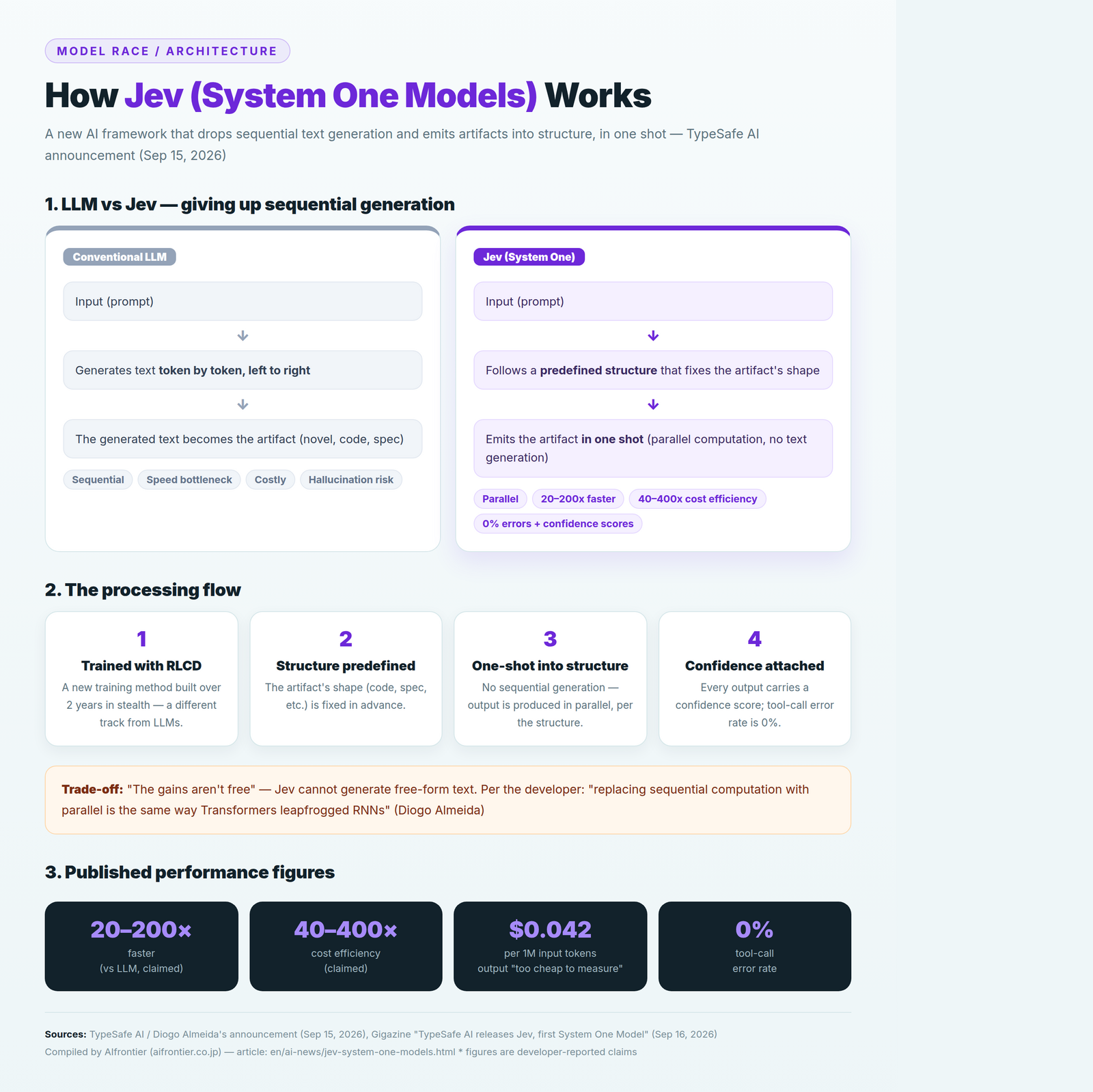
How to read the price and performance
Input costs $0.042 per million tokens, and the output side is described as unmeasurably cheap — effectively zero. In the published cost-versus-accuracy graph, Jev reportedly holds GPT-5.6 Terra-level quality at about one hundredth of the cost. TypeSafe describes out-of-schema type errors as structurally impossible. Choice and Score include confidence derived from their distributions; Noul returns a yes probability without a separate confidence field. In a Wikipedia race choosing among hundreds to thousands of links, Jev outran other models in non-reasoning mode — the compounding benefit, the maker says, of not hallucinating on high-cardinality choices.
Fit with Sign
One-shot emission into predefined structures, a zero error rate, and confidence scores on every output sit in the same stratum as what the Sign language aims for: a structured, safe language system that guarantees correctness through category-theory-based types and composition, backed by DPL-chip hardware guarantees. Giving up free text in favor of structure raises the verifiability of agent execution — a natural fit with Sign's design philosophy (zero reserved words, category theory, zero-cost abstraction). The Sign Board section on the Sign page explores this connection further.
Speed, price, comparative performance and calibration are TypeSafe provider claims. Schema conformance does not guarantee semantic correctness or API availability. The connection to Sign is AIfrontier’s design analogy, not an official integration or partnership.